Tuesday, July 14, 2009

5th entry: Disorders of organs

Besides introducing the various organs in our digestive system, I have decided to go further into the topic of digestion. Hmm, I guess I shall look into the disorders of our few main organs, such as stomach, small intestine and large intestine.

Firstly, I shall list out the problems, ( those highlighted in red are the ones I will talk about )

Stomach disorders:
-Peptic ulcers
-Gastric cancer

Small intestine disorders:
-Coeliac disease
-Peptic ulcers
-Infections of the digestive tract

Large intestine disorders:
-Appendicitis
-Constipation
-Diarrhoea
-Diverticulitis
-Irritable bowel syndrome
-Inflammatory bowel disease
-Crohn's disease
-Ulcerative colitis
-Colorectal polyps
-Rectal bleeding
-Colon or rectal cancer

Gastric cancer

It forms in tissues lining the stomach. Also can be called 'stomach cancer'.

Treatments:
surgery, chemotherapy, radiation therapy, immunotherapy, and vaccine therapy

Infections of the digestive tract

There are numerous types of bacteria that can infect the digestive system e.g. salmonelle enteritis, shigella enteritis and E. coli enteritis. The risk of infection is greater in some countries where the level of hygiene is lower.

Some symptoms of the illness will be
Vomiting
Diarrhoea
Nausea
Abdominal cramps
Abdominal pain

Treatments:
Patient counselling
Surgery

Constipation

Constipation is a symptom where a person has difficulty passing faeces.
Constipation is mostly common in children and older age, but can affect anyone.

Constipation might be mainly caused by:
Dehydration
Poor diet
Low-fiber diet
Inadequate water intake
Laxative abuse
Inadequate exercise

Treatments:
Drinking more water
Exercise more in the future
Eat high-fiber food

Crohn's Disease

Crohn's disease is an ongoing disease of the digestive or gastrointestinal (GI) tract.
The hallmarks of Crohn's disease are swelling of the GI tract, abdominal pain, and frequent diarrhea.
The condition can affect any area of the GI tract, from the mouth to the anus.

Causes: An over-reactive immune response may result in symptoms, such as diarrhea and abdominal pain.

Treatments:
There is currently no cure for Crohn's disease. The overall treatment goal for people living with the condition is to control symptoms to a degree that allows them to feel better and live as normally and actively as possible. They can do so by control inflammation, ensuring good nutrition and relieving abdominal pain & diarrhea.

References:

http://www.wrongdiagnosis.com/medical/bacterial_infections_of_the_digestive_tract.htm
http://www.cancer.gov/cancertopics/types/stomach
http://www.wrongdiagnosis.com/sym/constipation.htm
http://www.wrongdiagnosis.com/c/crohns_disease/treatments.htm
http://www.wrongdiagnosis.com/c/crohns_disease/causes.htm

4th entry: Parts of our digestive system (continued)

I shall continue from my last post.

The Rectum

The rectum is the final part of the large intestine.

It is where faeces is stored before being passed out of the body through the anus.

The Anus

The anus is the opening through which faeces is passed out of the rectum and are gotten rid of from the body. The act of passing faeces out is called a 'bowel movement' or 'opening your bowels'.

The anus is surrounded by very strong sphincter muscles. These muscles normally help to keep the anus closed. It will contract and expand to open the anus for 'bowel movement'.

The Liver

The liver is a huge organ that can weigh up to 3 kg.

The liver produces bile(a dark green digestive liquid produced by the liver), a substance that helps to break down fats. The bile break down the fats into tiny fat droplets. Bile produced in the liver is transferred to the gallbladder where it is stored until needed for digestion

The liver stores iron, vitamin B12 and copper.

Another function of the liver is to make cholesterol and other fats that are needed by the body.

The Gall Bladder

The gallbladder is a small 10 cm long pear-shaped organ.(picture above) It is located near the duodenum and the liver. It's connected to the liver and the duodenum through small tubes.

It's main function is to store bile.

When the bile is stored in the gallbladder, it becomes more concentrated and have more ability to do its work.


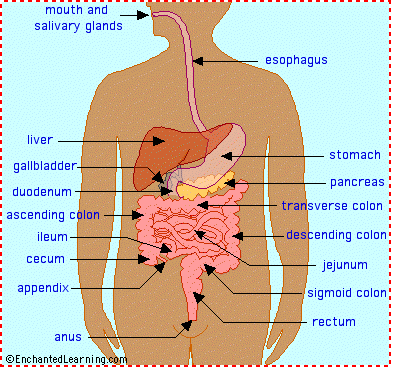
Basically, our digestive system are made up of the following organs:

-Mouth ( Teeth, Tongue, Salivary Glands )
-Oesophagus
-Stomach
-Small intestine( Duodenum,Jejunum,Ileum )
-Liver
-Gall Bladder
-Large intestine( Caecum, Appendix, Colon, Rectum)
-Anus


----------------------------------------------------------------------------------
In our body, there might be disorders in some of our organs. I will talk about them on my next post.


References:


http://www.enchantedlearning.com/subjects/anatomy/digestive/color.GIF
http://www.acm.uiuc.edu/sigbio/project/digestive/late/rectum.jpg
http://bettercancersolutions.com/detoxification/liver_diagram.gif
http://www.gesa.org.au/digestive-system/large_intestine.cfm
http://www.gesa.org.au/digestive-system/liver.cfm
http://www.gesa.org.au/digestive-system/gallbladder.cfm
http://www.gesa.org.au/digestive-system/anus.cfm

Monday, July 13, 2009

3rd entry: Where do the undigested food go?

Where do the undigested food go?

The large intestine
Large intestine is the part of the digestive system where waste products(undigested food) from the food you eat are collected and processed into faeces.
The large intestine is about 1.5 m long, it consists of the caecum, appendix, colon and rectum.

The large intestine reabsorbs water and maintains the fluid balance of our body. It also can absorb vitamins and process undigested food. After that, it can help store the waste before they are gotten rid of.


Caecum

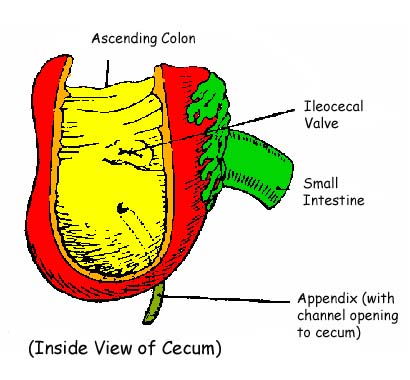
It is the first part of the large intestine. It looks like a small pouch and is located in the right lower abdomen. It connects small intestine to the colon.


The caecum accepts and stores processed material from the small intestine and moves them to the colon. As the processed food reach the end of the small intestine, a valve separating the small and large intestines opens, and the caecum expands for the material to enter.

The mixture normally contains:


-undigested food
-water
-some vitamins
-some minerals or salts

Appendix

The appendix is a small projection emerging from the caecum. ( Also shown in the picture of the Caecum above )

In a human body, the appendix has no function actually. If it gets infected of inflamed, it needs to be removed by surgery.

Colon

It's shaped like a inverted 'U', and is known to be the longest part inside our large intestine.

As faeces travels through the colon, the lining of the colon absorbs most of the water and some vitamins as well as minerals. There are bacteria in the colon that chemically break down some of the fibre to produce nutrients for themselves and to nourish the cells lining the colon. The muscular movement of the colon helps to push the faeces into the rectum for further processes.

I will move further into the Rectum, Anus, Liver as well as the gall bladder on my next entry. That's all for today's post.

References

http://www.toilet-related-ailments.com/images/CecumColorNew.jpg

2nd entry: Our digestive system (continued)


As mentioned on my last post, after the food is being chewed and soften by our mouth, the food is led to the Oesophagus.

The Oesophagus
It is a muscular tube in our chest that connects the mouth and throat to the stomach.

The muscles in the wall of our oesophagus contracts and relaxes to push the bolus(chewed and soften food) to our stomach. This muscular movement is called peristalsis. NO digestion occurs in the oesophagus.


The stomach
The stomach lies between the oesophagus and the duodenum.


For us humans, our stomach has a relaxed, empty volume of about 45 ml. When it expands,it can hold about 1 litre of food. The stomach is surrounded by parasympathetic and orthosympathetic plexuses(networks of blood vessels and nerves in the anterior gastric, posterior, superior and inferior, celiac and myenteric), which regulate both the secretions activity and the motor activity of its muscles.


The stomach produces strong enzymes called 'gastric juice' which helps in disgestion.


The muscular walls of the stomach helps to move the food and acid around, causing them to mix together properly. When the acid mixes well with the food, the food will break down into smaller, easier to digest fragments.


The small intestine


The small intestine is more than 6 meters long, known to be the longest organ in our human body and it is located within the middle of the abdomen. It has three sections, the duodenum, jejunum and ileum.


Duodenum

It is the first part of the small intestine. It is C-shaped and about 25 cm long.

The duodenum receives the thick liquid mixture of partly-digested food and acid from the stomach. It neutralise the mixture in the alkaline environment. The duodenum also receives bile from the gall bladder and other enzymes from the pancreas. Glands in the duodenum produces mucus which is coated around mixture to make the passage down easier and smoother.

Jejunum and Ileum

The jejunum is the 1-2 m long, coiled mid-section of the small intestine.
The ileum is the final portion of the small intestine. It measures 2-4 m in length.

The inner linings of the jejunum and ileum contain very small finger-like bumps called 'villi'.
The bumps helps increase surface area and improves the small intestine's ability to absorb nutrients. The last stage of digestion is completed, when food and liquids are fully broken down into their nutrient components. For example:

-glucose from carbohydrates,
amino acids from proteins,
fatty acids and cholesterol from fats
-vitamins
-minerals
-salts
-water

--------------------------------------------------------------------------
There are some food which could not be digested fully. We can call them 'undigested food'. They as well, have to undergo processes to be released out of our body as they should not be staying inside. I will talk about all this on my 3rd entry.


Thursday, July 9, 2009

1st entry : What is digestion ?

Alright, this shall be my first post.

As you all know, any journal entry can't do without an introduction about what you are going to do. Thus, i shall introduce to you, my topic for today.

DIGESTION

Simple alphabets joined together to form this 9 letter word, "Digestion".
It might be simple and short, but some might still ask what it is.
That opened the topic question for my first entry, What is Digestion ?

In simple term, digestion is the mechanical(physical) and chemical breaking down of food into smaller or simpler components. These components which have been digested can be absorbed by the bloodstream.

Digestion is a form of catabolism.

Of course, you all will ask, " now, what is catabolism? "

Catabolism is the set of metabolic pathways, it breaks down molecules into smaller units and release the energy. Examples would be polysaccharides, lipids, nucleic acids and proteins. They are broken down into smaller units like monosaccharides, fatty acids, nucleotides and amino acids respectively.

For digestion to occur, we need to have a Digestive System in our bodies.
Our digestive system consist of many part. I shall only go into the mouth for today. I will elaborate on the rest on other days.

The mouth

The mouth is the part where digestion begins at. Without the mouth, i do not think digestion could proceed any further. The mouth could be broken up into a few components. They are the teeth, tongue and the salivary glands. The teeth helps to chew our food, which breaks the large complex food into smaller pieces. At the tongue, the chewed up food will be rolled into soft balls with the help of the salivary gland, which creates the saliva needed to soften the food. After being chewed, rolled and soften, the bolus(chewed up and soften food) is finally able to continue its journey into our stomach!


Picture of our mouth:
--------------------------------------------------------------------------------
As food could not possibly juz get into our stomach right after being chewed and soften...
Our body also have an organ called Oesophagus. I will talk about it on my next entry.


References:
http://www.blogaholics.ca/wp/uploads/illu_mouth.jpg
http://hes.ucfsd.org/gclaypo/digestive_system.html#What%20is%20Digestion
http://en.wikipedia.org/wiki/Catabolism
http://en.wikipedia.org/wiki/Digestion